What load factor measures
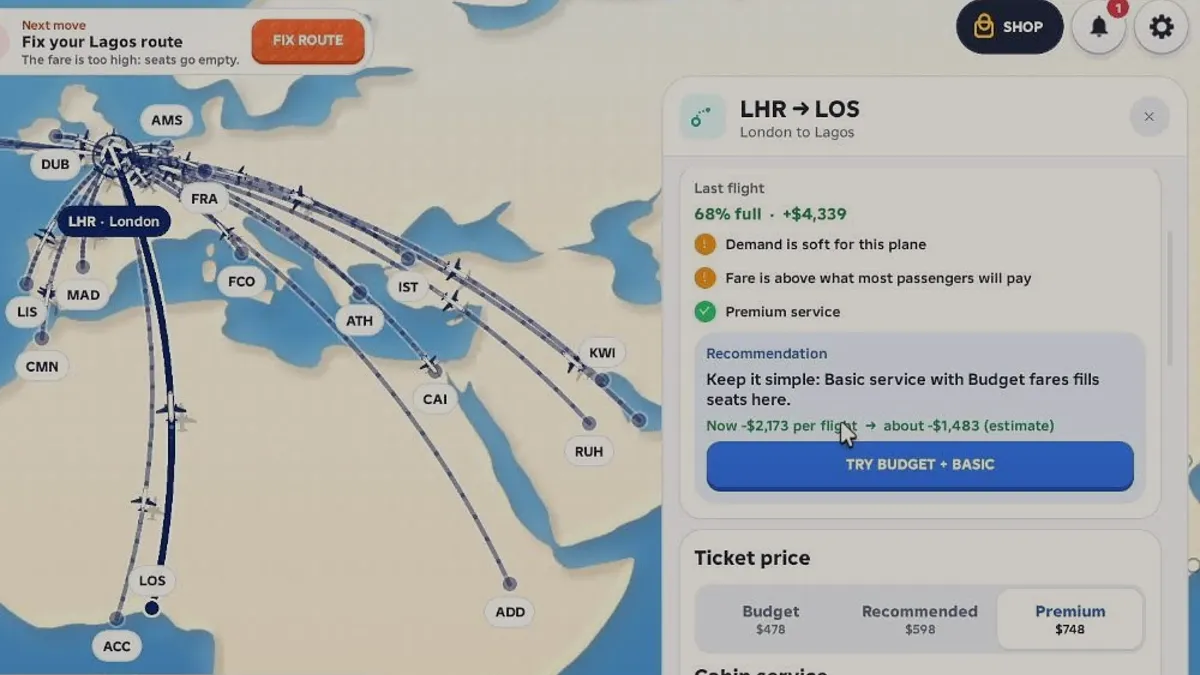
Load factor is passengers carried divided by seats offered, expressed as a percentage. The reviewed London–Lagos flight reported 68% full, which on a 48-seat aircraft would be about 33 passengers.
That single number separates the two big failure modes. If the cabin is under-filled and the fare is high, price is the problem. If the cabin is under-filled and the aircraft is much larger than the route's demand, capacity is the problem.
Reading the percentage
| Target | Observed load | Likely cause | Next test |
|---|---|---|---|
| Under 50% | Cabin clearly under-filled | Fare too high, or aircraft far too large | Cut the fare one tier first |
| 50–75% | Partial fill | Workable but not healthy | Try the budget tier for one flight |
| Above 75% | Strong fill | Demand is meeting or exceeding supply | Test one tier up if cash is positive |
The 68% case
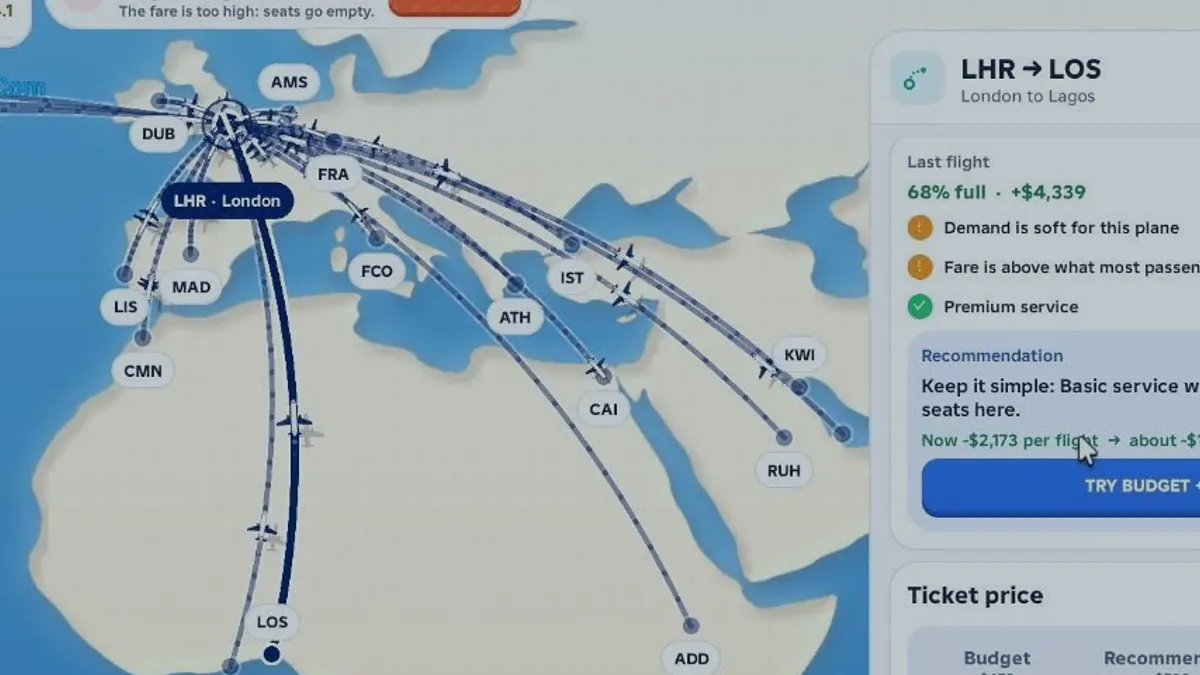
Sixty-eight percent is not a disaster. The reviewed flight still posted +$4,339, and the game's warning was about the fare being above what most passengers would pay — not about the route being unviable.
That distinction matters because players often close routes that are actually profitable. A warning is a direction of travel, not a verdict.
When low load is a capacity problem
- The route filled before you changed aircraft.
- The current aircraft's seat count is far above the passengers carried.
- Lowering the fare fills seats but the per-flight result barely moves.
- The route card warns that demand is soft for this plane.
Load factor questions
What load factor should I aim for?
No target is published. Use 75% as a practical working line: below it, price and capacity deserve a test; above it, a higher fare tier is worth one experiment.
Does load factor include crew or empty seats?
The card reports a single percentage against the aircraft's seat count, which the fleet panel states explicitly. No separate crew or blocked-seat figure is shown.
Can demand be increased directly?
No demand control was visible in the reviewed sessions. Demand responds to route, aircraft and price; there is no observed marketing or frequency lever.
Why does the warning say 'for this plane'?
Because demand is judged against the aircraft assigned to the route. That wording is the game telling you the mismatch may be capacity rather than price.
Sources and references
- Run an airline — official Roblox experience page
Supports the game identity, creator, release date, server size, genre and the published feature list quoted on this site.
Accessed - Roblox Games API — universe 10768550253
Supports visit count, favourites, active players, maximum server size, genre tags and the created/updated timestamps used in the snapshot table.
Accessed - Roblox votes API — universe 10768550253
Supports the 1,432 up / 208 down vote counts behind the 87.3% approval figure. Approval is computed, not published by Roblox.
Accessed - Roblox game passes API — universe 10768550253
Supports the six pass names and the effect wording quoted in the monetisation pages. It does not publish prices.
Accessed - Creator profile — monkeytherobloxdev
Confirms the creator account behind the experience. The profile itself carries no studio or support page.
Accessed - RUN AN AIRLINE FOR THE FIRST TIME:O — Zzzenvy
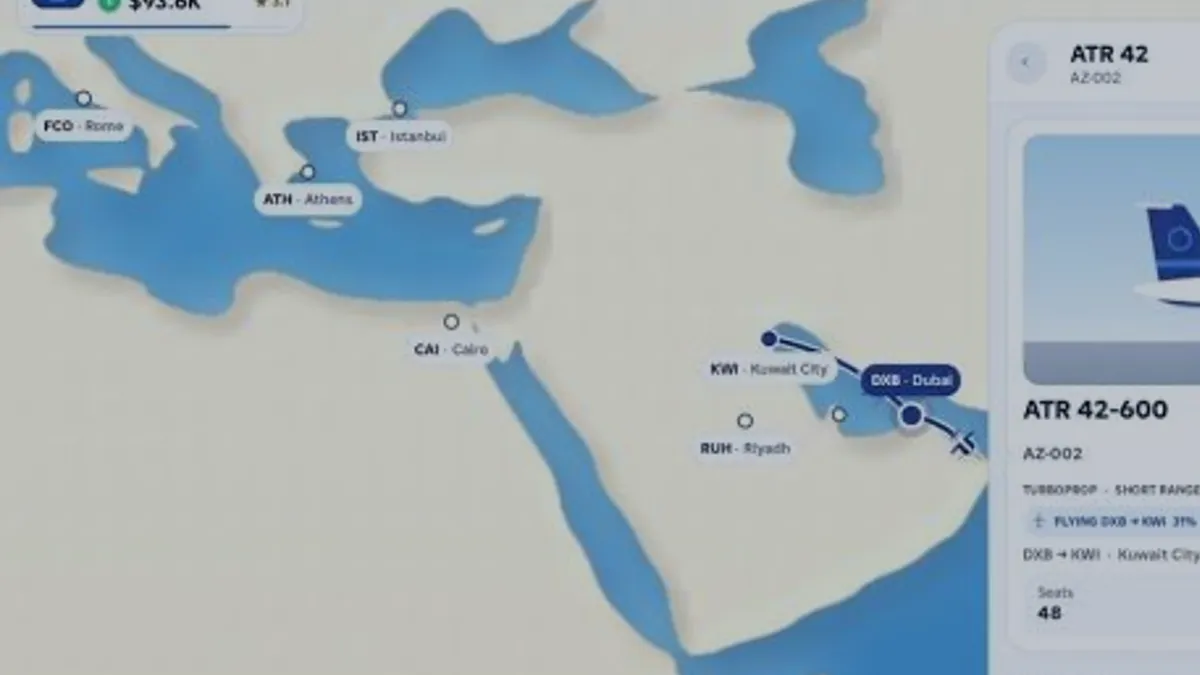
Public first-session recording used for the create-airline flow, the ATR 42-600 fleet panel (48 seats, 1,300 km, 500 km/h) and the DXB ↔ KWI 854 km / 3h example. Frame text only; no developer statement.
Accessed - ROBLOX playing run an airline — Krakenking17
Public live recording used for the LHR → LOS route card: fare tiers $478/$598/$748, 68% load, +$4,339 last flight, -$2,173 to -$1,483 recommendation, and cabin service at $3/$9/$20 per seat.
Accessed