The rule in one line
One aircraft per route you can keep filled. That is the whole fleet plan, and every other consideration is a refinement of it. A second aircraft adds seats; it does not add passengers.
The reviewed sessions show a single-aircraft airline at level 3 and a larger operation at level 15, which is consistent with fleet growth following route growth rather than leading it.
Fleet size against route coverage
| Target | Aircraft owned | Routes you can cover | Signal to grow |
|---|---|---|---|
| 1 aircraft | One short-range type | One sector, repeatable | Load factor above 75% twice in a row |
| 2–3 aircraft | Same type preferred | Two or three nearby sectors | Cash per flight positive on every route |
| Mixed fleet | Turboprop plus jet | Short feeders and one longer sector | The long sector beats a feeder on cash per hour |
Why commonality matters here
Two aircraft of the same type can be compared directly: same seats, same range, same block time. That makes it obvious which route is underperforming. A mixed fleet removes that control, because a difference in result could come from the aircraft rather than the route.
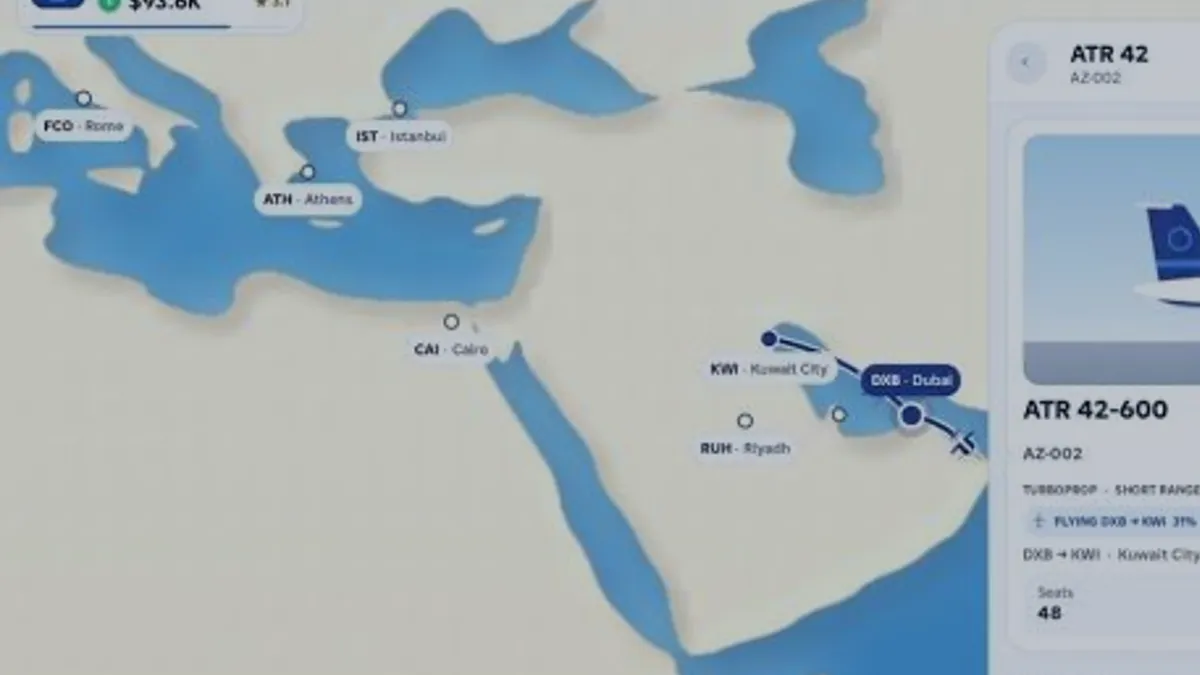
Keep the fleet uniform until you have a route that genuinely cannot be served by the current type, such as a sector beyond 1,300 km for the ATR 42-600.
A simple growth test
Confirm the current routes fill
Every existing route should be at or above your target load factor.
Confirm every route is cash positive
A new aircraft cannot fix a route that loses money; it multiplies the loss.
Find a route with no aircraft
If a legal, unserved destination exists, a purchase has a purpose.
Keep a reserve after paying
Do not spend to zero; a fare experiment needs a buffer, not a loan.
Fleet planning questions
Should I sell an aircraft I no longer need?
A sell or lease-back control was not observed in the reviewed sessions. Assume purchases are commitments and check your own client for a disposal option before buying a type you only need briefly.
Is a mixed fleet ever better?
Yes, once one route genuinely needs the range or seat count of a second type. The cost is losing the like-for-like comparison, so make the switch for a specific route rather than for variety.
How much reserve should I keep?
No official figure exists. A working rule is to keep enough cash to run your worst route twice at a loss, so a single bad experiment does not block the next repair.
Do more aircraft raise my level faster?
Level thresholds are not published. Fleet growth and level growth move together in the reviewed sessions, but no causal rule can be stated from two observations.
Sources and references
- Run an airline — official Roblox experience page
Supports the game identity, creator, release date, server size, genre and the published feature list quoted on this site.
Accessed - Roblox Games API — universe 10768550253
Supports visit count, favourites, active players, maximum server size, genre tags and the created/updated timestamps used in the snapshot table.
Accessed - Roblox votes API — universe 10768550253
Supports the 1,432 up / 208 down vote counts behind the 87.3% approval figure. Approval is computed, not published by Roblox.
Accessed - Roblox game passes API — universe 10768550253
Supports the six pass names and the effect wording quoted in the monetisation pages. It does not publish prices.
Accessed - Creator profile — monkeytherobloxdev
Confirms the creator account behind the experience. The profile itself carries no studio or support page.
Accessed - RUN AN AIRLINE FOR THE FIRST TIME:O — Zzzenvy
Public first-session recording used for the create-airline flow, the ATR 42-600 fleet panel (48 seats, 1,300 km, 500 km/h) and the DXB ↔ KWI 854 km / 3h example. Frame text only; no developer statement.
Accessed - ROBLOX playing run an airline — Krakenking17
Public live recording used for the LHR → LOS route card: fare tiers $478/$598/$748, 68% load, +$4,339 last flight, -$2,173 to -$1,483 recommendation, and cabin service at $3/$9/$20 per seat.
Accessed