What the card already tells you
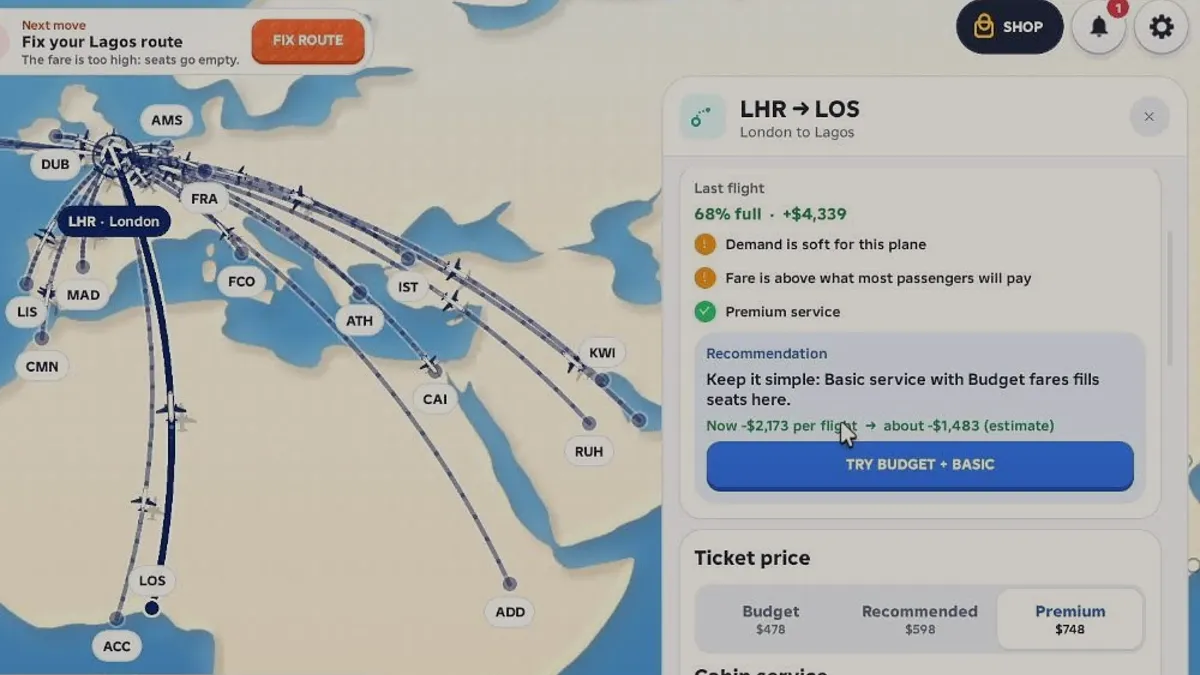
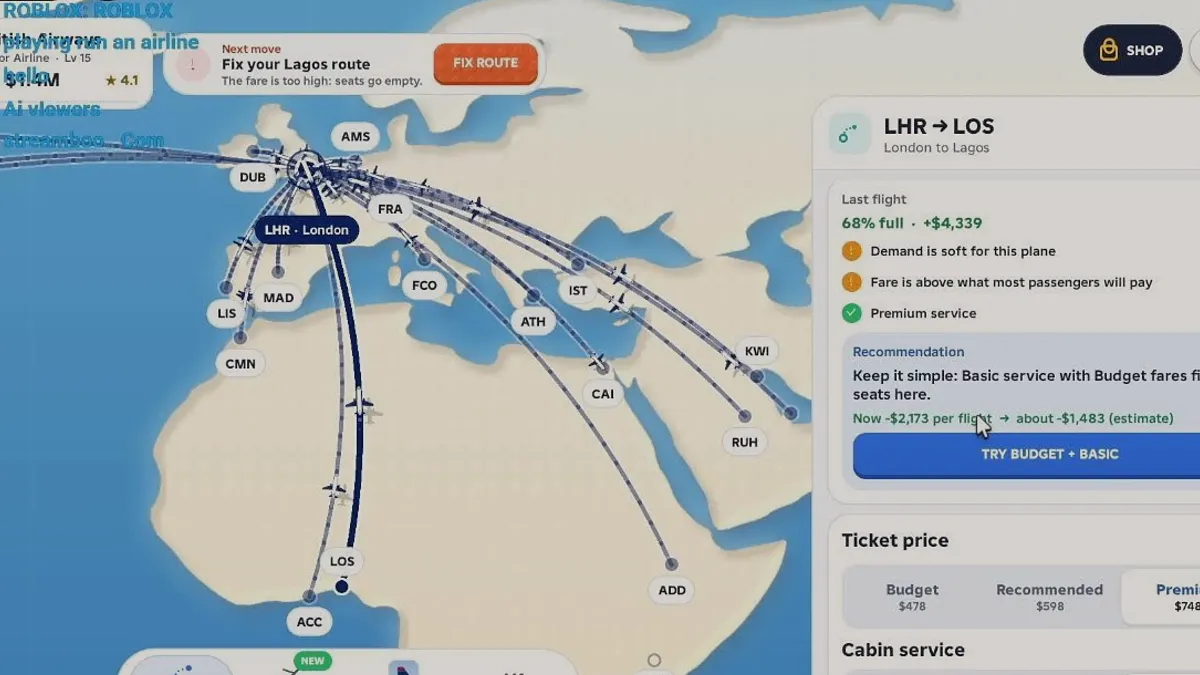
The route card reports a per-flight cash figure, the load factor that produced it, the fare tier in use and the cabin service price per seat. Those four values are enough to reconstruct the revenue side of the flight without knowing the game's internal formula.
Revenue is fare × seats × load factor. Service cost is service price per seat × seats. What remains is the aircraft's operating cost, which you can back out by subtracting the reported result from the reconstructed revenue.
- Budget fare
- $478
- Recommended fare
- $598
- Premium fare
- $748
- Basic service
- $3 per seat
- Comfort service
- $9 per seat
- Premium service
- $20 per seat
The worked example
Take the reviewed London–Lagos flight: 68% full and +$4,339. If that aircraft had 48 seats, the cabin carried about 33 passengers. At the $598 recommended fare that is roughly $19,734 of ticket revenue before service cost.
That arithmetic is an illustration of the method, not a reconstruction of the actual flight — the aircraft type on that route was not visible. The point is that three readable values already bound the result closely enough to make decisions.
The four numbers worth tracking
| Target | Metric | How to get it | What it decides |
|---|---|---|---|
| Net per flight | Cash result | Read directly on the route card | Whether the route is viable at all |
| Break-even load | Minimum load factor | Cost ÷ (fare × seats) | Whether demand can ever pay for the flight |
| Net per hour | Net ÷ block time | Use the quoted time, not distance ÷ speed | Which route deserves the aircraft |
| Margin | Net ÷ revenue | Reconstruct revenue from fare, seats and load | How much room a fare cut has |
Cheap ways to improve a flight
- Move down one fare tier before touching the aircraft.
- Cut cabin service to basic while testing demand.
- Fly the same route again rather than opening a new one.
- Reassign an aircraft that is too large for its route.
- Stop premium service on routes that never fill.
Profit questions
Does the game show revenue separately from profit?
No. The route card shows the net per-flight result and its inputs; it does not split ticket revenue, service cost and operating cost into separate lines.
Why can a full flight still lose money?
Because a full cabin at a low fare may not cover the per-seat service cost plus the aircraft's operating cost. Load factor is a demand signal, not a profit guarantee.
What is a good margin in this game?
No benchmark is published. Use your own best route as the reference and treat any route far below it as a candidate for repair.
Do flights earn while I am away?
Offline earnings are not described and were not tested. Plan sessions around the quoted block time instead of assuming passive income.
Sources and references
- Run an airline — official Roblox experience page
Supports the game identity, creator, release date, server size, genre and the published feature list quoted on this site.
Accessed - Roblox Games API — universe 10768550253
Supports visit count, favourites, active players, maximum server size, genre tags and the created/updated timestamps used in the snapshot table.
Accessed - Roblox votes API — universe 10768550253
Supports the 1,432 up / 208 down vote counts behind the 87.3% approval figure. Approval is computed, not published by Roblox.
Accessed - Roblox game passes API — universe 10768550253
Supports the six pass names and the effect wording quoted in the monetisation pages. It does not publish prices.
Accessed - Creator profile — monkeytherobloxdev
Confirms the creator account behind the experience. The profile itself carries no studio or support page.
Accessed - RUN AN AIRLINE FOR THE FIRST TIME:O — Zzzenvy
Public first-session recording used for the create-airline flow, the ATR 42-600 fleet panel (48 seats, 1,300 km, 500 km/h) and the DXB ↔ KWI 854 km / 3h example. Frame text only; no developer statement.
Accessed - ROBLOX playing run an airline — Krakenking17
Public live recording used for the LHR → LOS route card: fare tiers $478/$598/$748, 68% load, +$4,339 last flight, -$2,173 to -$1,483 recommendation, and cabin service at $3/$9/$20 per seat.
Accessed