Repair before you cut
Closing a route throws away the demand knowledge you paid for. The cheaper experiment is to change the two settings that cost nothing to change: cabin service and fare tier.
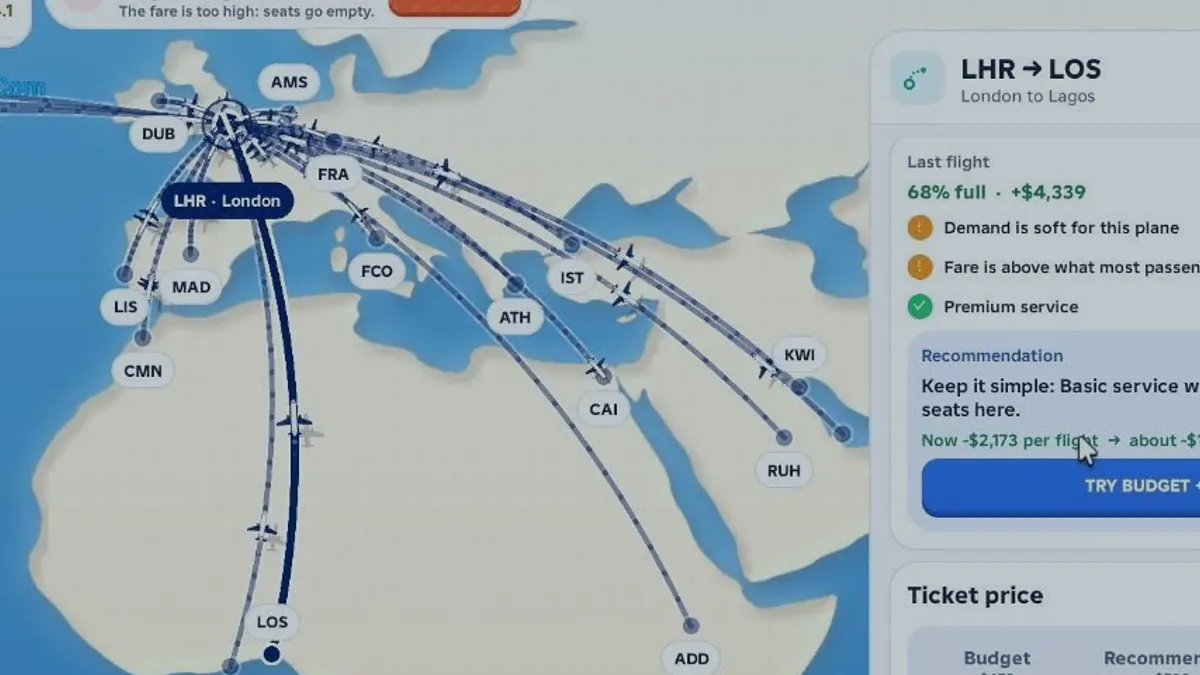
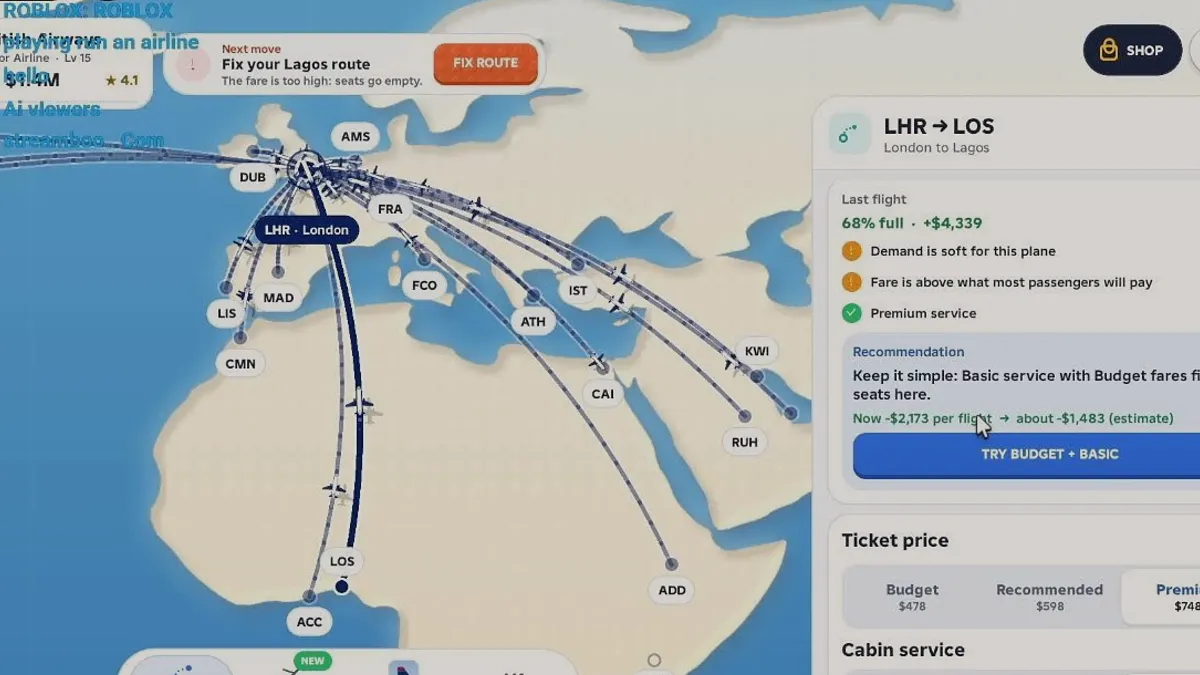
The reviewed Lagos route is the template. It was losing $2,173 per flight; the game's own recommendation was basic service with budget fares, estimated at about -$1,483. That is still negative, which is precisely why the next step matters.
The repair sequence
Cut service to basic
Basic was $3 per seat against $20 for premium in the reviewed session, the largest single cost lever.
Drop to the budget fare
Move one tier down, not to zero; the point is to fill seats, not to give them away.
Run one full flight
Do not judge the change on a partial cycle or on the estimate alone.
Decide with two numbers
Compare the new per-flight result and the new load factor against the old ones.
Repair outcomes and what they mean
| Target | After the repair | What it tells you | What to do |
|---|---|---|---|
| Still negative, fuller | Cash negative, load factor up | Cost per seat exceeds what the route can pay | Try a smaller aircraft, then close |
| Still negative, still empty | Cash negative, load unchanged | Demand is not there at any offered fare | Close the route |
| Positive and fuller | Cash positive, load factor up | The old settings were the problem | Keep it and consider a second route |
When closing is the right call
Close the route when the aircraft would clearly earn more elsewhere. That comparison needs cash per hour on both routes, not cash per flight, because the replacement route may be shorter and repeatable.
Closing is also correct when the route keeps producing the same warning after two repairs. Repeated identical warnings mean the constraint is structural — the city pair, the aircraft class or the distance — and no setting will fix it.
Route repair questions
Can a closed route be reopened?
Reopening was not observed in the reviewed sessions, so treat a closure as permanent until your own client shows a reopen control. That is another reason to repair first.
Should I cut the fare below budget?
Budget is the lowest tier the card offers. There is no observed control below it, so the remaining levers are service, aircraft and route choice.
Why is my route negative when the cabin is full?
Because the fare or the service cost is eating the revenue. A full cabin at a low fare can still lose money if cost per seat is high; the fix is service level, not more passengers.
Does closing a route hurt my rating?
The rating formula is not published. The reviewed sessions show the star rating moving between levels, but no evidence links a closure to a rating drop.
Sources and references
- Run an airline — official Roblox experience page
Supports the game identity, creator, release date, server size, genre and the published feature list quoted on this site.
Accessed - Roblox Games API — universe 10768550253
Supports visit count, favourites, active players, maximum server size, genre tags and the created/updated timestamps used in the snapshot table.
Accessed - Roblox votes API — universe 10768550253
Supports the 1,432 up / 208 down vote counts behind the 87.3% approval figure. Approval is computed, not published by Roblox.
Accessed - Roblox game passes API — universe 10768550253
Supports the six pass names and the effect wording quoted in the monetisation pages. It does not publish prices.
Accessed - Creator profile — monkeytherobloxdev
Confirms the creator account behind the experience. The profile itself carries no studio or support page.
Accessed - RUN AN AIRLINE FOR THE FIRST TIME:O — Zzzenvy
Public first-session recording used for the create-airline flow, the ATR 42-600 fleet panel (48 seats, 1,300 km, 500 km/h) and the DXB ↔ KWI 854 km / 3h example. Frame text only; no developer statement.
Accessed - ROBLOX playing run an airline — Krakenking17
Public live recording used for the LHR → LOS route card: fare tiers $478/$598/$748, 68% load, +$4,339 last flight, -$2,173 to -$1,483 recommendation, and cabin service at $3/$9/$20 per seat.
Accessed